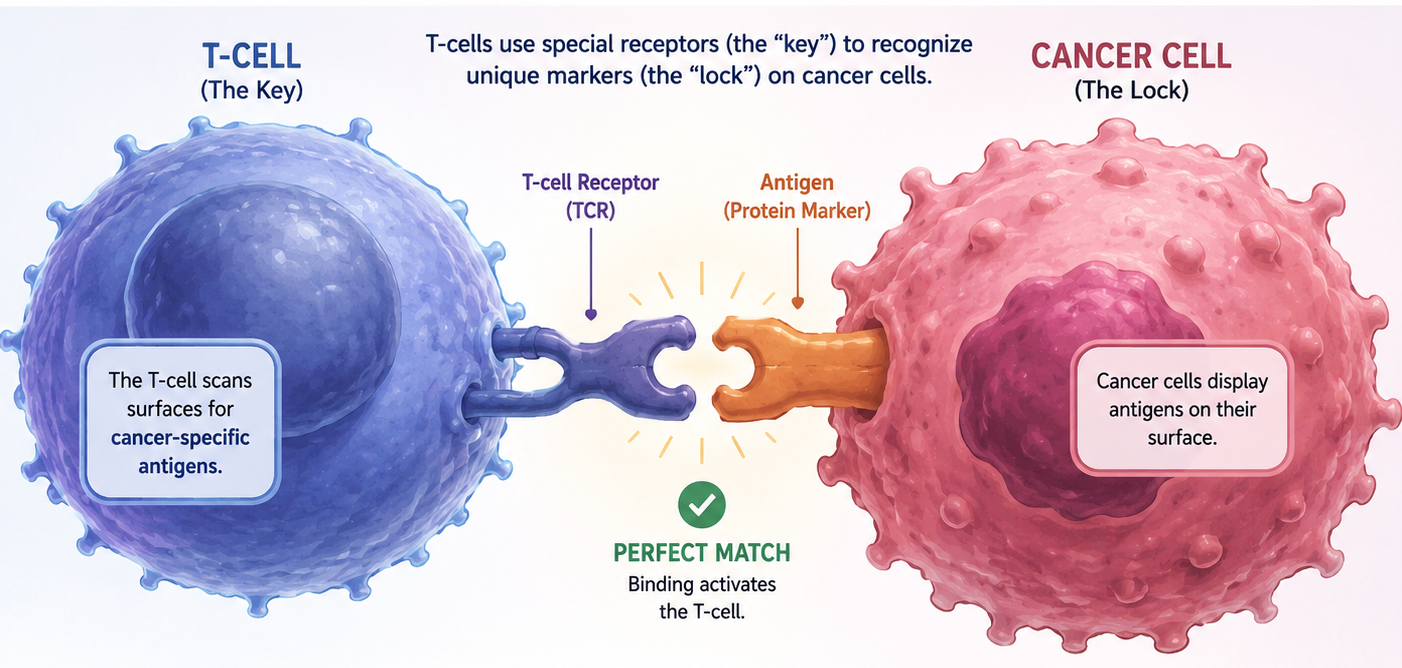
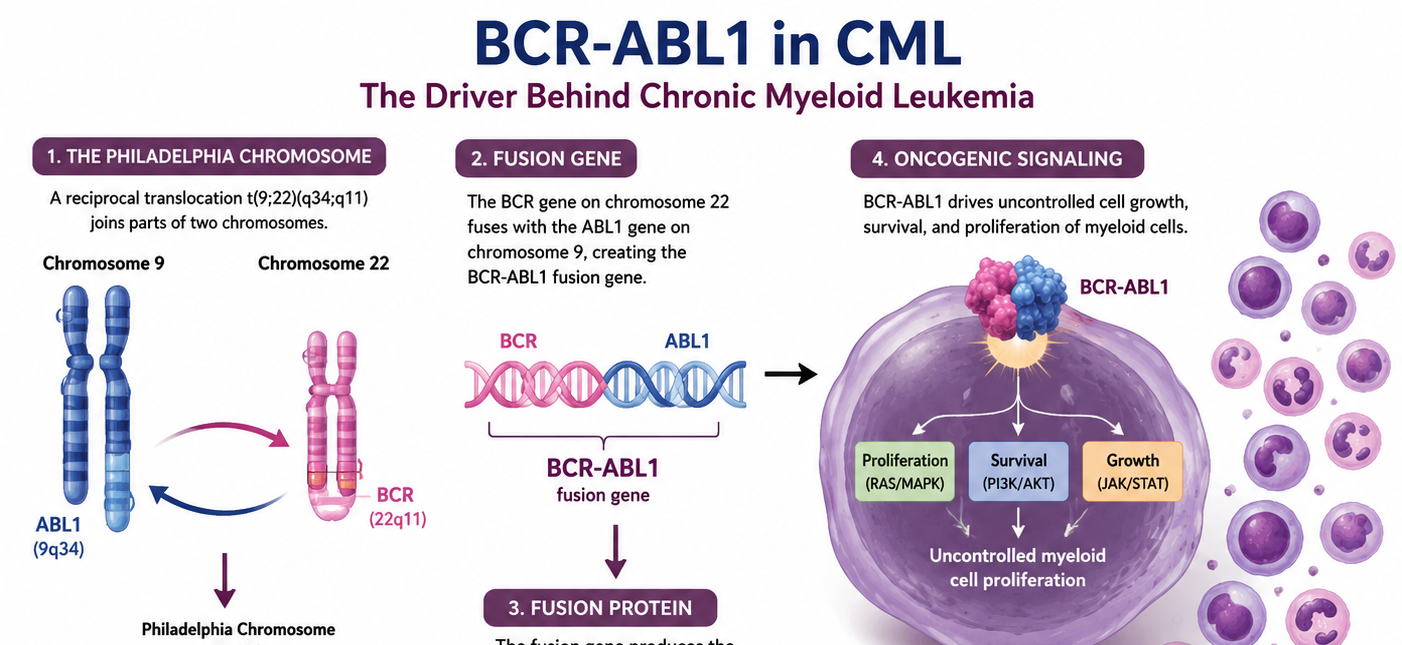
Chronic myeloid leukaemia (CML), a malignant disease derived from a haematopoietic stem cell clone, CML arises from the t(9;22)(q34;q11) balanced reciprocal translocation between chromosome 9 and 22 that forms the Philadelphia chromosome. The translocation event results in the fusion of the Breakpoint Cluster Region (BCR) gene with the Abelson proto-oncogene 1 (ABL1) gene, generating the BCR::ABL1 fusion gene. which produces an abnormal protein with continuously active tyrosine kinase activity. This protein promotes uncontrolled growth and survival of leukemia cells. The Philadelphia chromosome and BCR-ABL1 are important diagnostic markers of 90 % CML.
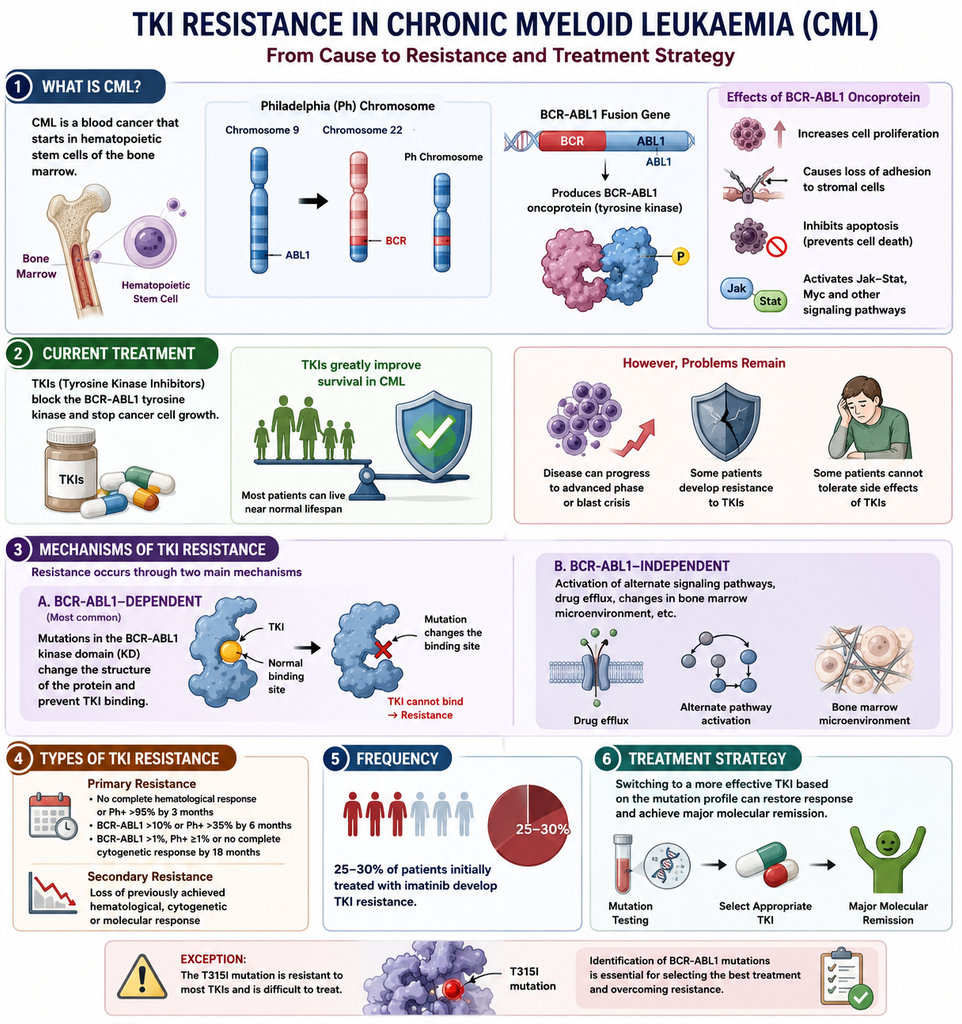
Tyrosine kinase inhibitors (TKIs) such as imatinib have greatly improved CML survival, and most patients can now live nearly normal lifespans. However, some patients develop TKI resistance, experience disease progression, or cannot tolerate treatment side effects. One of the most important causes of TKI resistance is the development of mutations in the BCR-ABL1 kinase domain. These mutations can change the structure of the BCR-ABL1 protein and prevent the TKI from binding effectively. Resistance may also occur through mechanisms that do not directly involve BCR-ABL1.
TKI resistance is defined based on the European Leukemia Net (ELN) recommendations. Resistance can be divided into primary and secondary categories Primary resistance is characterised by any of the following: No complete haematological response or Ph+ >95% by 3 months, BCR-ABL1 >10% or Ph+ >35% by 6 months, or BCR-ABL1 >1%, Ph + ≥1% or complete cytogenetic response by 18 months Secondary resistance is defined by the loss of a previously documented haematological, cytogenetic or molecular response.
Approximately 25–30% of patients initially treated with imatinib may develop resistance. For many patients, changing to another TKI based on the specific BCR-ABL1 mutation can restore treatment response and achieve a major molecular response. However, the T315I mutation is particularly difficult to treat because it strongly interferes with the binding of several TKIs. Therefore, identifying BCR-ABL1 mutations is important for selecting the most appropriate treatment and managing resistance. The most common mechanism of relapse for CML patients treated with Imatinib is the appearance of point mutations in the BCR-ABL oncogene that confer resistance to this drug. Insights into the emerging problem of resistance should promote the rational development of alternative, synergistic, and potentially curative treatment strategies.
THE QUESTION IS WHY AND HOW THESE TKD (Tyrosine Kinsase domain) MUTATIONS GET INTO THE PICTURE LATER.
The key point is that TKD mutations do not usually accumulate simply because the TKI “causes” mutations. The major mechanism is Darwinian selection of pre-existing or newly arising BCR::ABL1 mutant subclones under TKI pressure, followed in some cases by sequential selection of compound mutations.
Lets dive into the mechanistic model.
1. Why do BCR::ABL1 TKD mutations accumulate during TKI treatment?
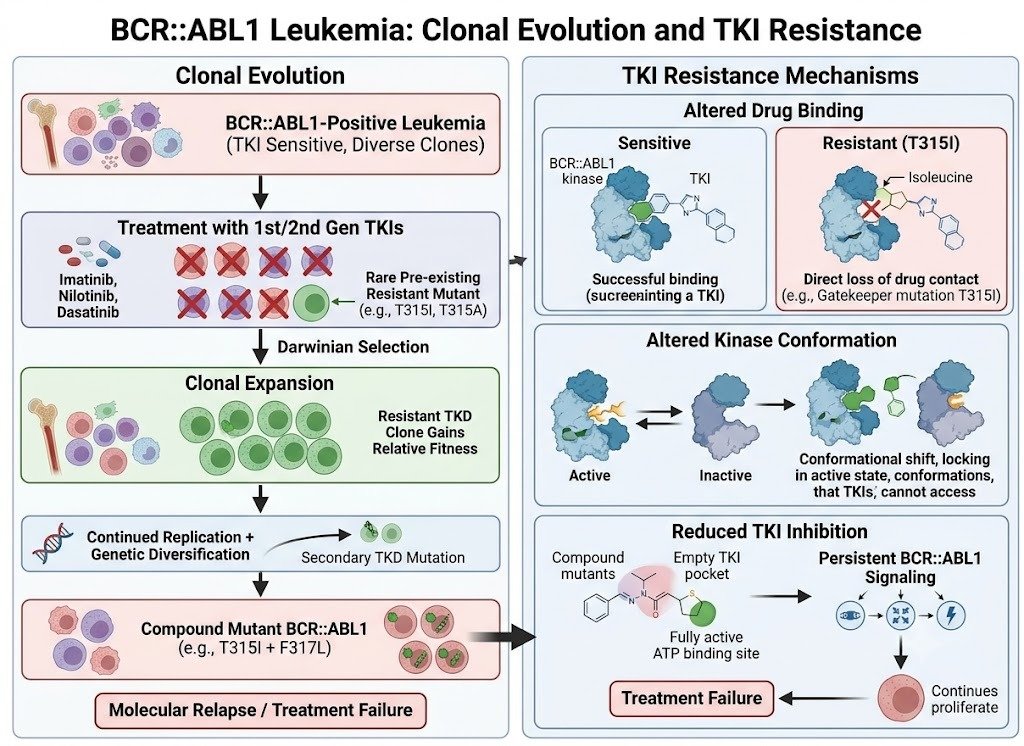
5Lets Think of CML as a population of genetically heterogeneous BCR::ABL1 -positive cells, rather than a population of identical cells. Before intitiating the treatment, the leukemia may contain 4 different clones of cells.
Clone A: BCR::ABL1 WT
Clone B: BCR::ABL1 + low-frequency Y253H
Clone C: BCR::ABL1 + low-frequency T315I
Clone D: BCR::ABL1 WT but genetically unstable
Most of the times the minor clones may remain clinically undetectable and When an ATP-competitive Tyrosine Kinase Inhibitor is given: TKI inhibits the sensitive BCR::ABL1 cells leading to death or suppression of sensitive clones, Now since there were other clones also present, of which some can be resistant clones,. These resistant clones survive and having no forceful inhibitions, resistant clones keep expanding.
Therefore, TKI treatment creates a strong selective bottleneck. The mutation that now becomes detectable after TKI treatment may therefore have pre-existed at low frequency rather than being newly induced by the drug. Experimental and clinical studies support the existence of pre-existing resistant subclones and subsequent selection (PMID: 14676625)
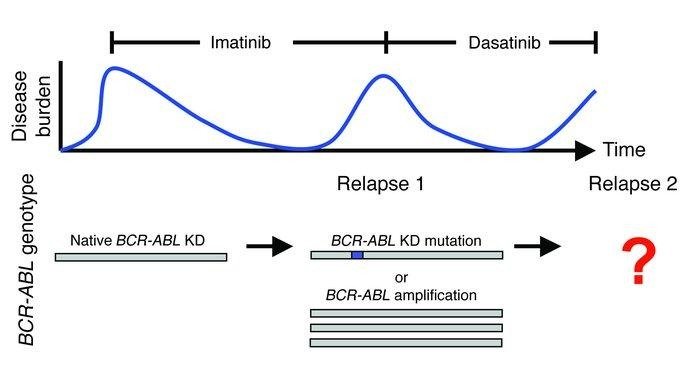
- How TKI resistance is associated to Relapse
2. The molecular mechanism behind: why does the first mutation survive?
Normally, ATP-competitive TKIs bind the BCR::ABL1 kinase domain and suppress its kinase activity. The survival strategy lies in the pathway.
Lets see the fusion event between BCR and the ABL1 kinase which leads to multiple oncogenic consequences. The coiled-coil domain of the BCR- N terminus facilitates dimerization and constitutive autophosphorylation of the ABL1 tyrosine kinase domain, resulting in subsequent phosphorylation of numerous substrates, including GRB2/GAB2, CRKL, JAK/STAT family members, MAPK, and PI3K/AKT pathways. The signaling pathways downstream of BCR-ABL1 are summarized in Figure-1 This entire pathways supports leukemia-cell survival. Despite this complexity, all downstream pathways appear dependent on the tyrosine kinase activity of BCR-ABL1, which is crucial to the clinical efficacy of BCR-ABL1 TKIs.
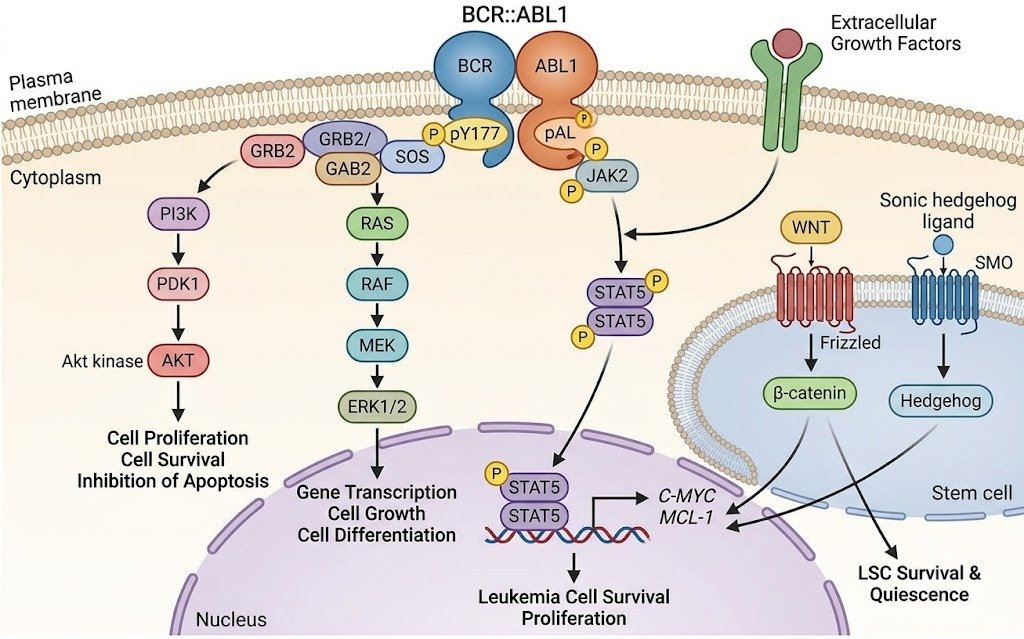
Figure-1: BCR-ABL1 dimerizes leading to autophosphorylation at tyrosine 177 of BCR. This serves as a docking point for the GRB2/GAB2/SOS complex which activates multiple signaling pathways, including PI3K/AKT and MAPK. Autophosphorylation of key residues in the BCR-ABL1 kinase domain also in turn activate the JAK/STAT pathway likely via activation of JAK2 and direct phosphorylation of STAT5. In the setting of BCR-ABL1 TKI resistance, extracellular growth factors can act via the JAK/STAT pathway to sustain cell growth. Leukemia stem cells may uniquely depend on WNT/β-catenin and SHH/SMO signaling for survival in the face of BCR-ABL1 kinase inhibition
Note: In reality, BCR-ABL1 is a cytosolic protein, not a transmembrane receptor. It is shown attached to or near the inner leaflet of the plasma membrane in the figure for visual and functional clarity.
Note: In the given figure pY177- stands for phospho-tyrosine 177 , pAL – stand for phosphorylated Activation Loop)
THE FACT
Being clear with the fact that BCR::ABL1 is active when ATP binds to the active site in the ABL1 kinase domain and transfers its phosphate group to ABL1 substrate. However, tyrosine kinase inhibitors (TKIs) compete with ATP for binding to the active site, inhibiting the BCR::ABL1 activation and preventing leukaemia . Now an ATP-competitive TKI attempts to block this mechanism, but a TKD mutation can alter the three-dimensional structure or drug-binding environment of BCR::ABL1 .
There are several underlying mechanisms.
A. Direct loss of drug contact
For an example (T315I) Threonine 315 is a critical contact/gatekeeper residue.
Replacing T → I, changes the geometry and eliminates important interactions required for several TKIs. Consequently downregulated TKI binding leading to reduced BCR::ABL1 inhibition , eventually causing mutant cell survives. T315I is therefore resistant to imatinib, dasatinib, nilotinib and bosutinib, while ponatinib was specifically designed to retain activity against T315I.
B. Conformational resistance
This is particularly important for understanding imatinib. Imatinib preferentially binds an inactive conformation of BCR::ABL1 . Some mutations alter the equilibrium:and favor the active state
Inactive BCR::ABL1 ⇌ Active BCR::ABL1
Therefore Mutation results in elevation or increased active kinase conformation reducing imatinib binding and therefore kinase remains active. This is a structural rather than simply a “drug-binding-site” mechanism.
C. P-loop mutations
The P-LOOP mutations examples include:
- G250E
- Y253F/H
- E255K/V
These alter the ATP-binding/P-loop region and can interfere with the structural rearrangements required for inhibitor binding. Thus a P-loop mutation alters kinase conformation reducing the affinity for TKI affinity leading to elevated residual kinase activity. Therefore different TKIs may face different vulnerabilities to these mutations. (PMID: 35884363 )
3. The really important part: why can a SECOND mutation appear?
This is where clonal evolution becomes important.
Suppose a patient develops WT BCR::ABL1 where Imatinib suppresses most cells. But a rare or few cells of BCR::ABL1 with T315I clones survives. Now imagine therapy is changed to a drug that suppresses most other BCR::ABL1 cells but has inadequate activity against that particular resistant clone. Therefore the T315I clone expands. Then, because leukemic cells continue to replicate and acquire genetic changes, a second mutation can arise within the same BCR::ABL1 allele.
For example:
A cell with T315I may show a second mutation E255K while clonally expanding. This is called a Compound BCR::ABL1 mutation. The important distinction is Polyclonal in nature, T315I → one clone, E255K → another clone, versus Compound mutation T315I + E255K → same BCR::ABL1 molecule/allele. The compound mutation latter is much more problematic. ELN specifically defines compound mutations as two mutations in cis, meaning they occur on the same BCR::ABL1 molecule/allele. This is why repeated sequential TKI exposure can create increasingly difficult resistance profiles. Importantly, this is selection, not necessarily TKI-induced mutagenesis. The TKI changes the fitness landscape.
4. Why does the second mutation sometimes make resistance much worse?
The second mutation may now have an additive or multiplied effect not simply numerical but it can be addition of functional alterations each attributing a different property. These effects of mutations can be non-additive numerically and much more than that.
Imagine that Mutation A confers 10-fold resistance and Mutation B confers 5-fold resistance. We might expect (A * B → 50-fold resistance) 50 fold resistance. But structural interactions and functional overlapping can produce much greater resistance than that. Therefore T315I + another resistance mutation can simultaneously:
- disrupt inhibitor contact,
- alter kinase conformation,
- reduce inhibitor affinity,
- preserve ATP binding,
- maintain kinase activity.
Thus the mutant kinase can remain functionally active despite high drug concentrations. Structural studies have shown that several T315I-containing compound mutants have particularly high resistance to multiple TKIs, including ponatinib (PMID: 25132497)
5. Why does T315I become such an important evolutionary bottleneck?
Because T315 is a gatekeeper residue, We can conceptualize the ATP-binding pocket as: The gatekeeper for the drug is T315 which is a kinase pocket. Now, Changing: T315 → I315, when the amino acid threonine is replaced by isoleucine it changes the physical and chemical environment of the pocket. Therefore: T315I acts as a major evolutionary escape route from several ATP-site TKIs. This is why switching from one conventional ATP-site TKI to another does not necessarily solve the problem.
6. Why “switching TKI” is therefore mutation-specific
The treatment strategy should not be such that if one TKI stopped working then choose another TKI. It should always be about determining the reason, then identify the BCR::ABL1 mutation and then select a TKI according to the resistance profile.”
For example, the 2025 ELN recommendations list:
| Mutation | TKIs with activity according to ELN |
| Y253H | Dasatinib, bosutinib, ponatinib, asciminib |
| E255K/V | Dasatinib, ponatinib, asciminib |
| V299L | Nilotinib, ponatinib, asciminib |
| T315I | Ponatinib, asciminib |
| F317L/V/I/C | Nilotinib, bosutinib, ponatinib, asciminib |
| F359V/I/C | Dasatinib, ponatinib |
These recommendations emphasize that the mutation itself should guide treatment selection.
7. The therapeutic problem gets more interesting with asciminib
Asciminib works differently.Most traditional TKIs are ATP-site TKI which targets ATP-binding pocket, but Asciminib targets myristoyl-binding pocket and causes an allosteric inhibition. So we have two mechanistically different ways of inhibiting BCR::ABL1 one is ATP-site inhibition and the other is an Allosteric inhibition via myristoyl-binding pocket. This creates an important Dual-site inhibition and therapeutic concept: Where Ponatinib targets ATP site and Asciminib targets myristoyl pocket, simultaneously inhibiting BCR::ABL1 through two structurally distinct mechanisms. Preclinical work demonstrated that combining asciminib with ponatinib can suppress the emergence of highly resistant compound mutants, and clinical evidence has subsequently supported this approach in selected patients with compound-mutant disease.
However, this is not a blanket recommendation that every patient should receive the combination; treatment depends on disease phase, mutation, prior TKIs, toxicity, response and specialist judgment (PMID: 31543464)
8. A particularly elegant mechanism: why combination therapy can prevent mutation accumulation
This is an important conceptual point for research.
With one TKI applied to a BCR::ABL1 population a large evolutionary space remains for resistant mutants and With two mechanistically complementary inhibitors, such as ATP-site inhibitor + allosteric inhibitor can simultaneously restricts two functional states/sites allowing fewer viable escape routes and narrow evolutionary space
In experimental systems, Asciminib + ponatinib reduced the emergence of resistant BCR::ABL1 mutants and restored activity against some compound mutants. Molecular modeling suggested cooperative effects between the two inhibitors.
So the strategy is not merely: “Kill the resistant cells.” rather It should be to “Reduce the evolutionary probability that a resistant clone can emerge.” That is a very important mechanistic distinction.
10. Where NGS becomes particularly valuable
Sanger sequencing can miss low-level mutations because its sensitivity is limited; the 2025 ELN recommendations note that mutations representing <20% of the leukemic burden may be difficult to detect. Targeted NGS can detect lower-frequency TKD mutations and, with appropriate read/linkage information, can help determine whether mutations are: in cis or compound mutation or in trans that are separate clones.
That distinction is biologically critical. For example:In Sample A, T315I is present in clone 1 and E255K in clone 2 is very different from: Sample B where T315I + E255K is present in the same BCR::ABL1 molecule. Clone-B represents a compound mutant with potentially very different drug sensitivity.
11. The most important treatment principle
The current ELN approach is essentially to:
Monitor molecular response closely. Detect emerging resistance at an early stage. Perform BCR::ABL1 tyrosine kinase domain (TKD) mutation analysis when clinically indicated. Select therapy according to the mutation-specific sensitivity profile. Avoid prolonged exposure to a TKI that is no longer effective.
The 2025 ELN recommendations state that BCR::ABL1 mutation testing is indicated with TKI resistance or early evidence of resistance, and that detection of a resistance mutation should generally trigger a change in therapy.
This is important because prolonged ineffective therapy gives a resistant clone time to expand and potentially acquire additional mutations.
CAN TKD MUTATION EXIST WITHOUT BCR-ABL1 FUSION?
Yes—but there is an important terminology distinction.
A classical “BCR::ABL1 TKD mutation” should not be present independently of the BCR::ABL1 fusion. When we say BCR::ABL1 TKD mutation such as T315I, E255K, Y253H, G250E, we mean a mutation occurring in the ABL1 kinase domain within the BCR::ABL1 fusion molecule. The standard clinical assays specifically amplify the BCR::ABL1 fusion transcript and then interrogate the ABL1 kinase domain.
But an ABL1 mutation can theoretically/biologically occur in the normal ABL1 gene without a BCR::ABL1 fusion. That is a different situation and should not automatically be called a BCR::ABL1 TKD mutation
There is a biological possibility of its occurrence, but the strongest literature support it for distinguishing normal ABL1 mutations from BCR::ABL1 kinase-domain mutations, rather than claiming that isolated normal-ABL1 TKD mutations are a common clinical phenomenon (PMID: 26864341). This study specifically investigates normal (non-fusion) ABL1 separately from oncogenic ABL1 fusion kinases, supporting the biological distinction between normal ABL1 and fusion-derived ABL1 kinase activity.
For the clinical definition of BCR::ABL1 TKD mutations, an even stronger reference is the European LeukemiaNet laboratory guideline: The guideline explicitly describes BCR::ABL1 TKD mutation testing and states that resistance-associated mutations are reported using the ABL1 kinase-domain reference sequence. Importantly, the mutations being assessed are mutations within BCR::ABL1 , not simply variants detected somewhere in the ABL1 gene (PMID: 37794101)
The distinction can therefore be stated more rigorously as: If mutation is in Normal ABL1 gene is termed as ABL1 variant or ABL1 mutation versus If BCR::ABL1 fusion gene is present then mutation in the ABL1-derived kinase domain is termed as BCR::ABL1 TKD mutation potentially causing TKI resistance.
The Association for Molecular Pathology guideline is also very clear that the mutations relevant to TKI resistance are mutations in the BCR-ABL kinase domain, and that these mutations are selected during TKI treatment.
One important caveat is If we have an NGS report saying “ABL1 p.T315I detected” but BCR::ABL1 is not detected, we should not immediately interpret that as BCR::ABL1 -T315I. We need to establish whether the variant is a normal ABL1 allele or BCR::ABL1 fusion transcript/allele.
That distinction is particularly important because T315I numbering is commonly used for BCR::ABL1 , and the ELN specifically recommends BCR::ABL1 -specific molecular testing for resistance assessment.
ABL1 mutations independent of the BCR::ABL1 fusion, and there is a useful distinction here: the strongest evidence comes from germline ABL1 variants and somatic ABL1 mutations in BCR::ABL1 -negative solid tumors. These are biologically different from the classic CML BCR::ABL1 -TKD mutations.
1. Germline ABL1 mutations — completely independent of BCR::ABL1
They identified germline ABL1 p.Tyr245Cys and p.Ala356Thr variants in affected individuals. Importantly, these are mutations in the native ABL1 gene, not mutations occurring in a BCR::ABL1 fusion. Functional experiments showed increased ABL1 kinase activity (PMID: 28288113)
2. Somatic ABL1 mutations in BCR::ABL1 -negative lung cancer
“Somatically mutated ABL1 is an actionable and essential NSCLC survival gene.”
This is probably the best paper for the exact conceptual question. The authors identified somatic ABL1 mutations in NSCLC, including: ABL1 R351W and ABL1 G340L. These mutations occurred in lung cancer cells without requiring a BCR::ABL1 fusion. They demonstrated that the mutated native ABL1 protein had increased signaling activity and that the cancer cells were sensitive to ABL inhibitors.
3. Somatic ABL1 mutation in colorectal cancer
A third example is “C1222C Deletion in Exon 8 of ABL1 Is Involved in Carcinogenesis and Cell Cycle Control of Colorectal Cancer Through IRS1/PI3K/Akt Pathway.” The investigators identified an ABL1 exon-8 deletion in colorectal cancer samples and investigated its relationship with ABL1 expression and the IRS1/PI3K/AKT pathway. This represents an
The central concept in Brief
TKD mutations accumulate during TKI therapy primarily because treatment creates a selective evolutionary bottleneck: rare resistant BCR::ABL1 clones survive, expand, and can subsequently acquire additional mutations, producing compound mutants whose altered kinase structure can escape multiple TKIs.
And that leads to a powerful research concept: CML TKI resistance is not only a drug-binding problem—it is an evolutionary problem. The most rational treatment therefore combines early molecular monitoring + mutation-resolved NGS + mutation-directed TKI selection + strategies that minimize the evolutionary opportunity for compound resistance.
References
- Nardi V, Azam M, Daley GQ. Mechanisms and implications of imatinib resistance mutations in BCR-ABL. Curr Opin Hematol. 2004 Jan;11(1):35-43. doi: 10.1097/00062752-200401000-00006. PMID: 14676625. Apperley et al., 2025 — European LeukemiaNet recommendations for CML management. This is the most current major guideline source and contains the mutation-specific treatment table and discussion of compound mutations.
- Poudel G, Tolland MG, Hughes TP, Pagani IS. Mechanisms of Resistance and Implications for Treatment Strategies in Chronic Myeloid Leukaemia. Cancers (Basel). 2022 Jul 6;14(14):3300. doi: 10.3390/cancers14143300. PMID: 35884363; PMCID: PMC9317051.
- Cross et al., European LeukemiaNet laboratory recommendations. Particularly useful for the molecular mechanism, mutation testing, NGS and interpretation of compound mutations.
- O’Hare et al., Cancer Cell, 2009. Development/mechanistic basis of ponatinib and its activity against T315I.
- Zabriskie et al., Cancer Cell, 2014. Excellent mechanistic paper on BCR::ABL1 compound mutations, structural resistance and ponatinib resistance.
- Eide et al., Cancer Cell, 2019. Important mechanistic study showing that asciminib + ponatinib can suppress emergence of resistant compound mutants.
- Recent clinical validation, 2024. A clinical case demonstrated successful targeting of a BCR::ABL1 compound mutant with combined ponatinib + asciminib, providing clinical support for the dual-site strategy in selected resistant disease.
- Huang L, et al. Germline mutations in ABL1 cause an autosomal dominant syndrome characterized by congenital heart defects and skeletal malformations. Nat Genet. 2017;49:613–618. doi:10.1038/ng.3815.
- Dasgupta Y, Koptyra M, Hoser G, Kantekure K, Roy D, Gornicka B, Nieborowska-Skorska M, Bolton-Gillespie E, Cerny-Reiterer S, Müschen M, Valent P, Wasik MA, Richardson C, Hantschel O, van der Kuip H, Stoklosa T, Skorski T. Normal ABL1 is a tumor suppressor and therapeutic target in human and mouse leukemias expressing oncogenic ABL1 kinases. Blood. 2016 Apr 28;127(17):2131-43. doi: 10.1182/blood-2015-11-681171. Epub 2016 Feb 10. PMID: 26864341; PMCID: PMC4850868.
- Cross NCP, Ernst T, Branford S, Cayuela JM, Deininger M, Fabarius A, Kim DDH, Machova Polakova K, Radich JP, Hehlmann R, Hochhaus A, Apperley JF, Soverini S. European LeukemiaNet laboratory recommendations for the diagnosis and management of chronic myeloid leukemia. Leukemia. 2023 Nov;37(11):2150-2167. doi: 10.1038/s41375-023-02048-y. Epub 2023 Oct 4. PMID: 37794101; PMCID: PMC10624636.
- Testoni E, Stephenson NL, Torres-Ayuso P, Marusiak AA, Trotter EW, Hudson A, Hodgkinson CL, Morrow CJ, Dive C, Brognard J. Somatically mutated ABL1 is an actionable and essential NSCLC survival gene. EMBO Mol Med. 2016 Feb 1;8(2):105-16. doi: 10.15252/emmm.201505456. PMID: 26758680; PMCID: PMC4734836.
- Short, N.J., Kantarjian, H., Kanagal-Shamanna, R. et al. Ultra-accurate Duplex Sequencing for the assessment of pretreatment ABL1 kinase domain mutations in Ph+ ALL. Blood Cancer J. 10, 61 (2020). https://doi.org/10.1038/s41408-020-0329-y
- Cross NCP, Ernst T, Branford S, Cayuela JM, Deininger M, Fabarius A, Kim DDH, Machova Polakova K, Radich JP, Hehlmann R, Hochhaus A, Apperley JF, Soverini S. European LeukemiaNet laboratory recommendations for the diagnosis and management of chronic myeloid leukemia. Leukemia. 2023 Nov;37(11):2150-2167. doi: 10.1038/s41375-023-02048-y. Epub 2023 Oct 4. PMID: 37794101; PMCID: PMC10624636.